⚡️ Key Takeaways
→ Choose Canva if your “eBook” is a 12–20 page visual lead magnet, a worksheet, or a cover, and you also need a tool for social posts, slide decks, and team brand assets.
→ Choose Designrr if your eBook starts as a blog post, podcast, YouTube video, Word doc, or PDF — and especially if you want to publish to Kindle, ePub, flipbook, audiobook, or a KDP paperback from the same source.
→ Best setup: Designrr alone for the eBook itself. It covers what Canva can’t (content import, native Kindle/ePub export, multi-format publishing) and you can still drop in a Canva-designed cover if you want.
⚡️ Conclusion (read this first)
Canva is the best tool to design short visual content. Designrr is the best tool to manufacture an eBook from content you already have. If you want Canva’s design polish without the copy-paste-by-paragraph workflow — and you want a Kindle file, a flipbook, and an audiobook from the same source — Designrr sits in the middle of “I have content somewhere” and “I have a finished publication” in a way Canva was never built to.
Both tools can technically make an eBook. Only one was built for it.
The old version of this article said Canva was capped at 30 pages. That’s no longer true — Canva now supports up to 350 pages per design, and 500 in some document formats. But page count was never really the problem. The problem is workflow: what happens when you’ve already written your eBook in Google Docs, or recorded it as a podcast, or published it as 12 blog posts, and you need to turn it into a polished, branded, multi-format publication without spending three weekends pasting paragraphs.
Designrr currently has 320,000+ customers and ~2,500 active users creating eBooks every day. That number isn’t there to brag. It’s there because eBook creation is a specific job, and the tools that win the job are the ones built for it.
Designrr vs Canva: Quick Comparison
| Designrr | Canva | |
|---|---|---|
| Best For | Repurposing existing content into eBooks, lead magnets, Kindle books, audiobooks, flipbooks | Short visual designs — social graphics, presentations, posters, short lead magnets, covers |
| Standout Feature | Import from blog URL, YouTube, podcast, PDF, Word, Google Doc — one source, every format out | Magic Studio AI suite (Magic Design, Dream Lab, Magic Write) + massive template library |
| Pros | Multi-format publishing from one source · Automatic TOC + page numbers · Native Kindle/ePub/Flipbook/Audiobook · 922 Google Fonts · Lifetime deal available | Easiest learning curve · Best template library on the market · Strong AI image generation · Excellent for team brand assets |
| Cons | Steeper learning curve · Lifetime-deal upsells for ePub/Kindle export · Some editor friction | No content import from URLs/blogs/audio/video · No automatic TOC or page numbers · No native ePub/Kindle/Flipbook export · Manual layout per page |
| Price | Lifetime $27 (one-time) · Standard $29/mo · Pro $39/mo · Premium $49/mo | Free · Pro $15/mo · Business $10/user/mo (3-seat min = $30/mo floor) |
| Content Import Sources | Blog URL, MS Word, Google Docs, PDF, YouTube, podcast, audio, video | None (file uploads for images/video only) |
| Output Formats | PDF, Kindle ePub, ePub for iBooks, Flipbook, HTML embed, Audiobook, KDP Print Book | PDF, PNG, JPG, MP4, GIF, PPTX, DOCX |
| Templates | 100 (Standard) / 300+ (Pro+) + 200+ cover designs | 250,000+ free / 1.6M+ across all formats |
| Editing Approach | Global “Make Changes To All Elements” toggle + drag-and-drop | Drag-and-drop only — formatting per element |
| AI Features | WordGenie AI Writer · WordGenie Pro Chat · AI Image Generator (Premium+) · Dynamic Transcripts | Magic Studio: Magic Write, Magic Design, Dream Lab, Magic Edit, Magic Resize, Canva Sheets |
| Team Collaboration | Multi-user on Agency Premium ($249/mo) | Built-in on all paid tiers; Brand Kits, approval workflows on Business |
| Trial / Guarantee | 7-day free trial · 30-day money-back guarantee | Free forever tier · Pro free trial available |
Who is Canva best for?
- Solo marketers and creators who need one tool for social posts, presentations, and the occasional short eBook
- Small teams that share brand assets and want approval workflows
- Visual-first authors producing 8–20 page lead magnets where design impact matters more than long-form text handling
- Beginners who’ve never used a design tool — Canva’s onboarding is genuinely the easiest in the category
Note: For a deeper look at Canva alternatives that handle long-form content better, see our guide to [Canva alternatives for eBook creation].
Ivory M., Training & Technical Assistance Coordinator on Capterra: “Canva has been a game-changer for our organization for several reasons: its ease of use, diverse features, video and image editing tools, and the numerous templates available.”
Who is Designrr best for?
- Bloggers and content marketers who have 50+ blog posts they want to repurpose into eBooks and lead magnets
- Course creators, coaches, and consultants who record podcasts or YouTube videos and want them turned into companion eBooks
- Self-published authors publishing to Kindle, paperback (KDP), and flipbook from the same manuscript
- Agency owners managing eBook production for multiple clients
Note: If you’re brand new to repurposing, start with [how to turn a blog post into an eBook in 15 minutes] — it walks through the Designrr workflow end-to-end.
Sagi S., CEO (Design, 11–50 employees) on Capterra: “I love the effectiveness of being able to write eBooks that serve as lead gens so quickly. The fact that I can turn every one of my articles into eBooks or sometimes even podcasts. Now with the new AI tool I wrote a full eBook in like 5 mins.”
Designrr as an Alternative: Why People Switch From Canva for eBooks
The reason most people end up at Designrr after starting with Canva is the same reason most people end up at a dishwasher after starting with a sponge. Canva works. It just doesn’t scale to the job.
Here’s what changes when the tool is built for eBooks specifically.
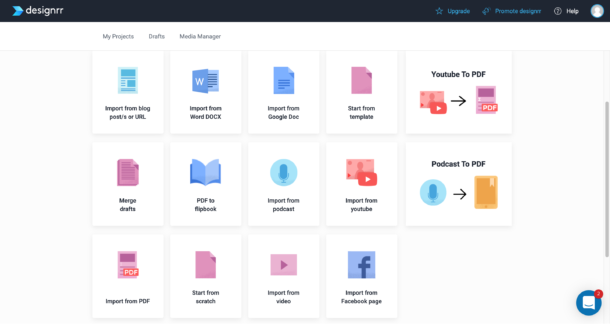
1. Import from anywhere — blog URL, YouTube, podcast, Word, Google Doc, PDF
Designrr is the only mainstream tool that takes a content source and outputs a formatted eBook automatically.
- Paste a blog URL — Designrr strips navigation, ads, and sidebars and pulls the article into the editor
- Drop in a YouTube URL — Designrr auto-transcribes the audio AND captures scene-change screenshots, aligning each to a timestamp (Dynamic Transcripts, Premium+)
- Paste a podcast feed — auto-transcribed and laid out as a chapter
- Upload a Word doc, Google Doc, or textual PDF — full content + formatting flows in
In Canva, every paragraph is a copy-paste. A 30,000-word eBook is roughly an afternoon of moving text from Google Docs to Canva one section at a time, manually reflowing each page when text overflows.
2. Publish to every format from a single source
Write once, publish to every format your readers actually use:
- PDF — print-ready and web-optimized
- Kindle ePub and iBooks ePub (Pro+)
- Flipbook — embeddable on any site (Pro+)
- HTML embed — drop the eBook into a blog post or landing page (Premium)
- Audiobook — multi-speaker on Premium+
- KDP Print Book — Amazon paperback, full bleed, with cover dimensions calculated automatically (Premium+)
Canva exports to PDF, PNG, JPG, MP4, GIF, PPTX, and DOCX. That’s it. No native ePub, no Kindle, no flipbook. To get your Canva eBook on Kindle you export to PDF, then run it through a third-party converter (or pay a Fiverr freelancer to fix what the converter breaks).
3. Automatic TOC, page numbers, and global typography controls
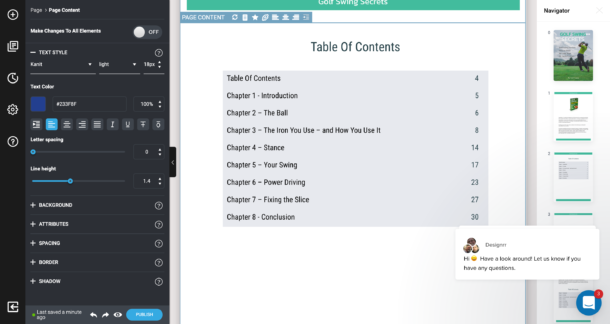
Designrr generates a linked table of contents from your headings automatically. Page numbers update as you edit. The “Make Changes To All Elements” toggle in the left sidebar lets you change a font across every paragraph in the eBook with one click.
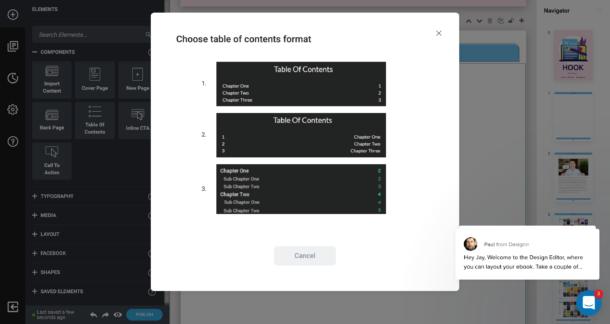
hen you can change the font type, size, color, background, even resize it and so on:
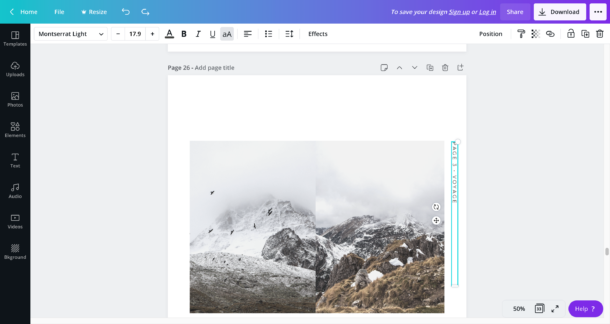
In Canva, you build the TOC manually — type each chapter name, type each page number, link each one to the right page. Adding a chapter in the middle? Renumber everything. Page numbers are manually typed text boxes you copy onto every page. Want to change body text from Lato to Inter? Click each text box.
Danielle N., Video Editor & Social Media Content Creator on Capterra: “The first eBook was manageable to create in Canva, but the next one was going to be a lot of work to paste everything into Canva. I thought there must be an easier way, and soon discovered Designrr. Canva is great for graphic design, but not so great for eBooks, because it doesn’t have automated page numbering and Table of Contents.”
4. AI built for eBook content, not graphic design
Both tools have AI in 2026 — but they’re aimed at different jobs.
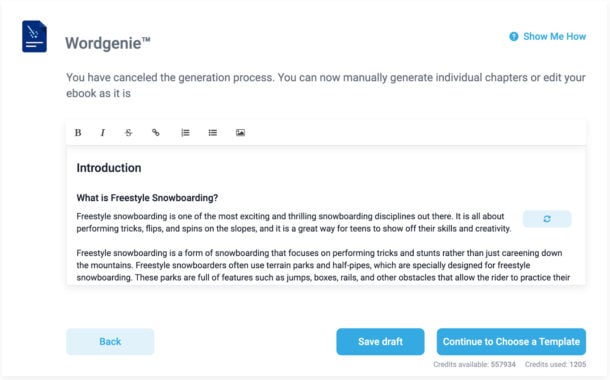
- Designrr’s WordGenie AI: writes eBook chapters, rewrites your existing text for tone or clarity, fixes spelling and grammar, optimizes structure, and generates AI images inside the document. WordGenie Pro Chat (Pro/Premium) handles long-form back-and-forth.
- Canva’s Magic Studio (launched October 2023): Magic Design for one-click templates, Magic Write for short-form copy, Dream Lab for AI image generation, Magic Edit for image inpainting, Magic Resize for repurposing graphics across social formats. Excellent — for graphics. Less useful for assembling a 60-page book.
Designrr Pricing
| Plan | Monthly | Best For |
|---|---|---|
| Standard | $29/mo | Solo creators, blog-to-eBook |
| Pro | $39/mo | Multi-format publishers, Kindle authors |
| Premium | $49/mo | Course creators using audio/video, KDP paperback |
| Business | $99/mo | Heavy podcast/video repurposing |
| Agency Premium | $249/mo | Agencies producing for multiple clients |
There’s also a $27 lifetime deal on the Standard plan — a one-time payment for permanent access. Heavy users typically upgrade to Pro for the Kindle/ePub/Flipbook exports.
Trust line: All plans include a 7-day free trial and a 30-day money-back guarantee.
Where Designrr Shines
- Automatic TOC + page numbers + global typography controls (the workflow Canva forces you to do by hand)
- Multi-format export from one source — PDF, Kindle, ePub, Flipbook, Audiobook, KDP Print Book
- Content import that actually works — blog URL strips ads and navigation, YouTube auto-transcribes
- $27 lifetime deal undercuts every recurring Canva plan on lifetime cost for serial eBook creators
Where Designrr Falls Short
We hear these regularly — and they’re fair:
- Learning curve is real. If you’re coming from Canva expecting drag-and-drop simplicity, Designrr will frustrate you for the first day or two. The Help Center has 65+ video tutorials specifically because this complaint is common.
- The lifetime deal is a gateway, not the full product. PDF import, Kindle/ePub export, and the Flipbook generator sit on the Pro plan ($39/mo). The $27 entry price is real, but most users upgrade once they start publishing seriously.
- Image-based PDFs can’t be imported. If your source PDF is a scan, or was exported from Canva or InDesign as flattened images, Designrr can’t read the text. Only textual PDFs work.
- No native Mailchimp/ConvertKit/Zapier integrations. You’ll deliver eBooks via your existing tools, not from inside Designrr.
Allen S., ChatGPT Writer (Writing & Editing) on Capterra: “Designrr Desktop Publishing Service is like a fancy Swiss Army knife that comes in a box with half the blades missing. On paper, it promises a whole spread of bells and whistles… But when you roll up your sleeves and start clicking around, the shine comes off fast.”
Yadah H., Educator (E-Learning) on Capterra: “It’s impressive the number of formats you can upload to the Designrr site and it will create a beautiful eBook for you within a few minutes. You can insert blogs, PDFs, Word Documents and even Facebook posts and you’ll get a uniform and great product created with the tap of a few keys… The transcription option is fantastic for those who utilise a lot of video in their business.”
Andy Mahoney on Trustpilot (December 2025): “Bought Designrr in 2020 and completely forgot about it. Today I uploaded an old manuscript and tried the new WordGenie feature. Within minutes it was fixing typos, tightening sentences, and cleaning up the formatting.”
Canva vs Designrr vs Both: Price
| Canva | Designrr | |
|---|---|---|
| Free / trial | Free tier forever · Pro trial | 7-day free trial · 30-day money-back |
| Entry paid plan | Pro $15/mo ($120/yr) | Standard $29/mo · or $27 lifetime |
| Team starting price | Business $30/mo (3 seats × $10/mo annual) | Agency Premium $249/mo |
| eBook-specific tier | None — Pro covers everything | Pro $39/mo unlocks Kindle/ePub/Flipbook |
| Lifetime option | None | $27 one-time (Standard plan) |
Verdict: Canva wins on entry price for visual content. Designrr wins on lifetime cost — $27 once vs $120/year forever — if you’re producing more than one eBook a year.
Canva vs Designrr: Content Import
- Canva: No URL import. No audio/video import. File uploads accepted for images and video to use as embedded media. Text comes in by copy-paste, paragraph by paragraph.
- Designrr: Blog URL (with ad/nav stripping), MS Word, Google Doc, PDF (Pro+), YouTube (auto-transcribed), podcast, audio file, video file. All formats preserve structure where possible.
Verdict: This isn’t a comparison — it’s a category Canva doesn’t enter. If your eBook starts as content you already have, Designrr saves you days of copy-paste work.
Canva vs Designrr: Output Formats
- Canva: PDF Standard, PDF Print, PNG, JPG, MP4, GIF, PPTX, DOCX. No ePub, no Kindle, no flipbook. Canva users who publish to Kindle export PDF and run it through a third-party converter.
- Designrr: PDF (web + print), Kindle ePub, iBooks ePub, Flipbook, HTML embed, Audiobook, KDP Print Book paperback. All from the same project.
Verdict: Designrr wins decisively. If multi-format output matters, Canva isn’t a real option in 2026.
Canva vs Designrr: Templates and AI
- Canva: 250,000+ free templates, 1.6M+ across all formats. Magic Studio AI suite is the best in the design-software category for generating graphics, resizing, and one-click design ideas. Not built for assembling long-form content.
- Designrr: 100 templates on Standard, 300+ on Pro+, 200+ cover designs, 922 Google Fonts. WordGenie AI handles writing, rewriting, structure optimization, and image generation inside the eBook context.
Verdict: Canva has more templates and a more polished general-purpose AI. Designrr has fewer templates but every one is built for eBook layout — chapter pages, TOC pages, cover spreads, back matter — and its AI is aimed at long-form text.
How to Choose the Best eBook Tool for You
Five questions to make this concrete:
- Does your eBook start as existing content? (Blog, podcast, YouTube video, Word doc) → Designrr saves days. Canva will cost you them.
- Do you need a Kindle file or a KDP paperback? → Designrr (native). Canva → PDF + third-party converter + manual cleanup.
- Is it a 12–20 page visual lead magnet? → Canva’s template library wins.
- Do you also need social posts, slides, and ads from the same tool? → Canva. Designrr is single-purpose.
- What’s the lifetime cost? → If you’ll make more than 2–3 eBooks ever, Designrr’s $27 lifetime deal beats Canva’s $120/year subscription on TCO.
Final Verdict: Designrr vs Canva
If you’re producing visual content across many formats and the occasional short PDF eBook is part of that, Canva is the right tool. Its template library, Magic Studio AI, and brand-kit team workflow are unmatched in the design-software category.
If you’re producing actual eBooks — content-led, multi-chapter, sourced from blog posts or podcasts or videos, published to Kindle or KDP or flipbook — Designrr is the right tool. The workflow advantage isn’t subtle. Importing a blog URL and watching a 5,000-word post become a formatted eBook in 30 seconds is the kind of “first time using the product” moment that decides this comparison.
You can use both: Canva for the cover art, Designrr for the eBook itself. Plenty of people do.
Sign up for Designrr’s special offer today!
Designrr vs Canva: Frequently Asked Questions
Everything you need to know before choosing between Designrr and Canva for your next eBook
Is Designrr better than Canva for eBooks?
Yes for repurposing existing content into multi-format eBooks (blog to Kindle, podcast to flipbook, YouTube to PDF). No for short visual lead magnets under 20 pages where Canva’s template library and AI-driven design ideas win. The right choice depends on whether your eBook is content-led (Designrr) or design-led (Canva).
Can Canva export to Kindle or ePub in 2026?
No. Canva exports to PDF, PNG, JPG, MP4, GIF, PPTX, and DOCX only. To publish a Canva file to Kindle, you export PDF and convert it with a third-party tool (Kindle Create, Calibre, or a paid converter), then fix formatting manually. Designrr exports natively to Kindle ePub, iBooks ePub, and KDP paperback from the same source file.
What is the page limit in Canva in 2026?
Canva supports up to 350 pages per design in the editor, with some document formats allowing up to 500. The old 30-page limit ended years ago. Page count isn’t the eBook problem with Canva — workflow is. Without automatic table of contents, page numbers, or global typography controls, long documents become unmanageable to maintain.
Does Designrr still have a $27 lifetime deal?
Yes. The $27 one-time lifetime deal is on the Standard plan. PDF import, Kindle/ePub export, and the Flipbook generator require an upgrade to the Pro plan ($39/mo) — but the lifetime entry point is real and active. It’s the most affordable way to access the core Designrr platform without recurring monthly fees.
Can Canva import a blog post or YouTube video into an eBook?
No. Canva has no URL import, no audio import, and no video transcription. Text moves into Canva by copy-paste, paragraph by paragraph. Designrr imports from blog URL, YouTube, podcast, PDF, Word, and Google Doc — and automatically strips navigation, ads, and sidebars when pulling from a blog URL.
Which is cheaper, Designrr or Canva, for serious eBook creation?
Designrr’s $27 lifetime deal beats Canva’s $180/year Pro subscription on total cost for anyone making more than one or two eBooks. Canva Pro is cheaper monthly at $15, but it’s a recurring cost forever. Over five years, Canva Pro costs $900 versus Designrr’s one-time $27 — though serious publishers often upgrade to Designrr Pro at $39/mo for Kindle and flipbook export.
Does Designrr have AI like Canva’s Magic Studio?
Yes. Designrr’s WordGenie AI writes eBook chapters, rewrites text for tone and clarity, optimizes structure, and generates AI images inside the document. WordGenie Pro Chat (Pro/Premium) handles long-form back-and-forth. It’s aimed at long-form writing rather than graphic design, while Canva’s Magic Studio is the best in the design-software category for graphics, resizing, and one-click design ideas.
Can I use Canva to publish on Amazon KDP?
Partially. Canva can export PDF that you upload to KDP for paperback (with cover dimension workarounds), but it has no native Kindle ePub export. Designrr Premium includes a full Print Books workflow with auto-calculated KDP dimensions for paperback and hardcover, plus native ePub export for the Kindle version — all from the same project.
Is Canva good for long-form documents?
It’s workable up to around 200 pages, but the workflow is manual — no automatic table of contents, no automatic page numbers, no global typography controls, and no content reflow when you edit. The practical limit for sane production is usually 30 to 50 pages. Beyond that, maintenance becomes a significant time sink as you manually renumber pages and update TOC entries.
Can you use Canva and Designrr together?
Yes — many creators design covers and graphics in Canva, then import them into Designrr when assembling the full eBook. Canva for the front-of-funnel marketing visuals, Designrr for the actual publication. This combined workflow gives you Canva’s design polish for cover art and promotional materials, plus Designrr’s multi-format publishing capability for the eBook itself.