Here’s what nobody tells you when you’re pricing your ebook: the platform you choose matters more than the content itself when it comes to what you can charge.
If you’re selling a business guide on Amazon, you’re capped at $9.99 to earn maximum royalties. The same guide sold on your own website through Gumroad or Payhip? You can charge $47, $97, or even $297—and keep 90-95% of every sale.
After analyzing pricing strategies across platforms from Amazon KDP to Teachable, Gumroad to self-hosted solutions, I’m going to show you exactly how to price your ebook based on where you’re selling, who you’re selling to, and what you’re actually offering.
The short answer for content creators and entrepreneurs is this: think ecosystem, not ebook. Your ebook pricing strategy should be fundamentally different depending on whether you’re:
- A traditional author selling fiction on Amazon ($3.99-$4.99)
- A course creator using ebooks as lead magnets ($0-$27)
- A business consultant selling expertise direct ($47-$297)
- An entrepreneur building a content empire ($9.99 on marketplaces, $27+ direct)
Let me break down exactly what this means for your business.
Sign up for Designrr’s special offer today!
Your Platform Choice Determines Your Price Ceiling
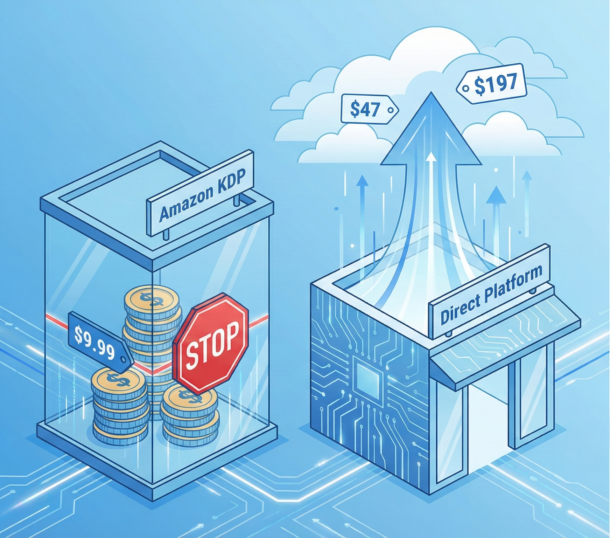
Most ebook pricing advice assumes you’re selling on Amazon. That’s backwards for content creators and entrepreneurs.
Your pricing strategy starts with answering three questions:
1. Where does your audience already live? If your audience is primarily on Amazon browsing for books, you need Amazon pricing strategies. If they’re on your email list, following you on YouTube, or in your community, direct sales makes more sense.
2. What is your ebook’s role in your business model? Is it your primary product, a lead magnet for courses, a credibility builder for consulting, or one piece of a larger content ecosystem?
3. What percentage of your business do you want platform-dependent? Relying 100% on Amazon means following their rules. Direct sales channels mean more control but more marketing responsibility.
Let’s break down your options.
Direct Sales Platforms Give Content Creators the Highest Margins
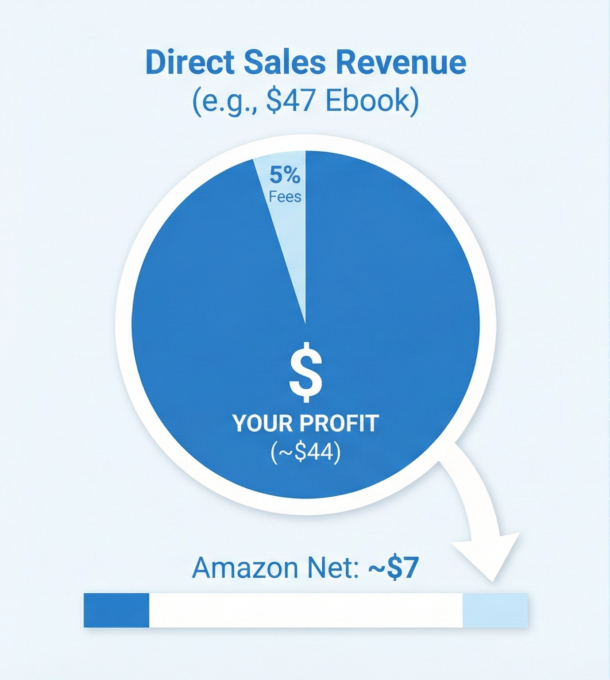
For content creators, course creators, and entrepreneurs, direct sales platforms offer the highest margins and the most pricing flexibility.
Your Own Website Keeps 95% or More of Every Sale
When you sell directly through your own website, you keep everything except payment processing fees (typically 2.9% plus $0.30 per transaction).
| Platform | Fee Structure | Best For |
|---|---|---|
| Payhip | 5% per sale | Creators who want automatic EU VAT handling and low fees |
| Gumroad | 10% per sale | Digital creators who want built-in marketplace exposure |
| Sellfy | $29-$199/month, 0% transaction fees | High-volume sellers who benefit from flat monthly pricing |
| SendOwl | $9-$39/month | Creators who need to integrate with existing websites |
| Shopify | $39-$399/month | Businesses wanting complete store control and scalability |
Pricing freedom: $0-$997+ (literally no limits)
Real example: A $47 ebook sold through Payhip earns you approximately $44.17 after fees. The same content sold on Amazon at $9.99 earns you $6.93. That’s 537% more profit per sale.
Direct sales work best when you have an email list (minimum 1,000 subscribers recommended), you’re selling business or professional content with clear ROI, you want to bundle ebooks with courses or coaching, or you’re building a personal brand beyond just books.
| Content Type | Recommended Direct Sales Price Range |
|---|---|
| Lead magnets and email list builders | $0-$9 |
| Standard ebooks (50-100 pages) | $19-$47 |
| Comprehensive guides (100-200+ pages) | $47-$97 |
| Premium content with bonuses and templates | $97-$297 |
Course Platforms Let You Position Ebooks as Educational Products
If you’re a course creator, your ebook often works best as part of a larger offering or as a standalone mini-course.
| Platform | Monthly Cost | Your Revenue Share | Best For |
|---|---|---|---|
| Teachable | $39-$199 | 91-97% | Positioning ebooks as “mini-courses” with video, worksheets, community |
| Thinkific | $49-$499 | 93-100% | Course libraries where ebooks are entry-level products |
| Kajabi | $149-$399 | 100% (no transaction fees) | Serious creators with established audiences who want all-in-one |
| Ebook Format on Course Platforms | Recommended Price Range |
|---|---|
| Ebook as standalone product | $27-$97 |
| Ebook plus video walkthrough | $47-$197 |
| Ebook plus community access | $97-$297/year |
| Ebook as course bonus | Free with course purchase |
Strategic insight: Course creators often undervalue ebooks. If your course sells for $497, your ebook component alone should be worth $47-$97 when sold separately. This creates perceived value for the full course.
Creator Economy Platforms Handle Technical Details While You Focus on Content
These platforms cater specifically to content creators and handle technical infrastructure while taking a cut.
| Platform | Fee | Net Margin | Best For |
|---|---|---|---|
| Gumroad | 10% of sales | ~85% after payment processing | Digital creators with social media audiences who want built-in marketplace |
| Payhip | 5% of sales | ~90% after payment processing | Anyone wanting lower fees than Gumroad, automatic EU VAT handling |
| Ko-fi | 0% (free plan) or $6/month | ~97% after payment processing | Creators with Patreon-style support models, selling as membership perks |
| Content Length | Recommended Price on Creator Platforms |
|---|---|
| Short guides (20-50 pages) | $9-$19 |
| Full-length ebooks (100+ pages) | $19-$47 |
| Premium specialized content | $47-$97 |
| Bundles (3-5 ebooks) | $47-$97 |
Marketplace Platforms Trade Higher Margins for Built-In Audiences
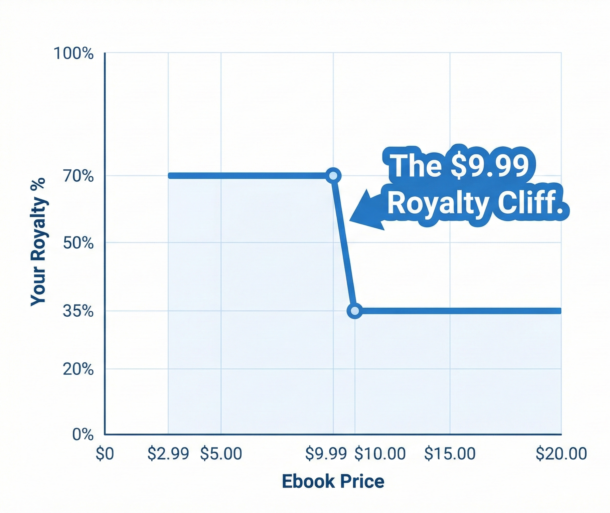
Marketplaces give you access to existing audiences but limit your pricing flexibility and take larger revenue cuts.
Amazon KDP Works Best for Traditional Authors Who Need Discovery
Amazon remains the largest ebook marketplace globally, but it’s designed for traditional publishing, not content creators.
Royalty structure explained:
| Price Range | Royalty Rate | Additional Costs |
|---|---|---|
| $0.99-$2.98 | 35% | None |
| $2.99-$9.99 | 70% | $0.15/MB delivery fee (typically $0.15-$0.45 for text ebooks) |
| $10.00+ | 35% | None |
What you actually earn after fees:
| List Price | Approximate Net Royalty |
|---|---|
| $2.99 | $2.03-$2.18 per sale |
| $3.99 | $2.73 per sale |
| $4.99 | $3.43 per sale |
| $9.99 | $6.93 per sale |
| $14.99 | $5.25 per sale (drops to 35% tier) |
Critical limitation: The $9.99 ceiling. Price your comprehensive business guide at $14.99 and you earn only $5.25 per sale (35% royalty). Keep it at $9.99 and earn $6.93. This makes Amazon terrible for premium content.
Amazon works best when you’re writing traditional fiction or narrative non-fiction, you want access to Kindle Unlimited readers, you have no existing audience and need marketplace discovery, or you’re comfortable with Amazon’s pricing restrictions.
| Content Type | Optimal Amazon Price |
|---|---|
| Fiction novels | $3.99-$4.99 |
| Non-fiction under 100 pages | $4.99-$6.99 |
| Comprehensive non-fiction | $7.99-$9.99 (never exceed $9.99) |
June 2025 update: Amazon reduced print royalties from 60% to 50% for books under $9.99, making ebooks relatively more attractive but not affecting ebook royalties.
Apple Books, Kobo, and Google Play Remove the $9.99 Price Ceiling
These platforms offer more pricing flexibility than Amazon with similar or better royalty rates.
| Platform | Royalty Rate | Price Ceiling | Best For |
|---|---|---|---|
| Apple Books | 70% at ALL prices | None | Premium content above $9.99 |
| Kobo | 70% from $2.99 | None | Canadian, Australian, and New Zealand markets |
| Google Play | 52-70% (most get 70%) | None | Global reach across 75+ countries |
The math that makes wide distribution essential for premium content:
| $14.99 Ebook | Amazon Earnings | Apple Books Earnings |
|---|---|---|
| Royalty rate | 35% | 70% |
| Your earnings | $5.25 | $10.49 |
Draft2Digital as Your Distribution Hub
Draft2Digital distributes to Apple, Kobo, Barnes & Noble, and library systems from a single dashboard.
Effective January 1, 2026, their royalty structure changed:
| Your List Price | Draft2Digital Royalty |
|---|---|
| $2.99 and above | 75% (highest among major distributors) |
| Under $2.99 | 40% |
Strategic advantage: If you’re pricing above $9.99, you MUST distribute beyond Amazon to maintain decent royalties. Amazon punishes premium pricing; Apple and Kobo reward it.
Global Sellers Need Regional Pricing Strategies
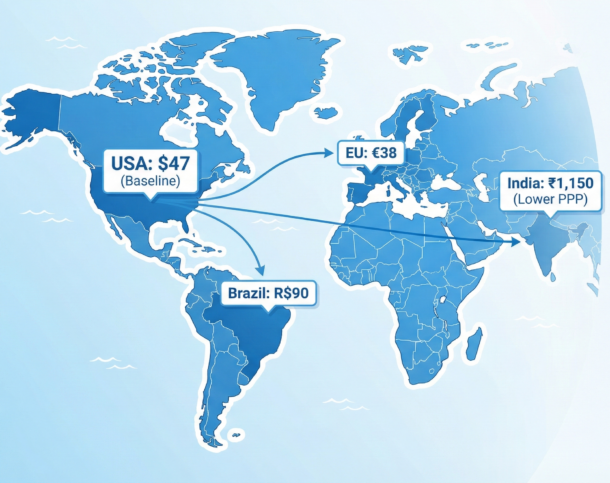
If you’re selling globally, platform choice matters enormously.
Regional price sensitivity compared to US baseline:
| Market | Price Sensitivity | Typical Discount from US Price |
|---|---|---|
| United States | Baseline | N/A |
| United Kingdom | 20-30% more sensitive | Set prices 15% lower |
| Germany | Similar to US | 0-10% lower |
| Southern Europe | More sensitive | 10-20% lower |
| Australia | Similar to US | 0-10% lower |
| India | Much more sensitive | 60-80% lower |
| Brazil | Much more sensitive | 50-70% lower |
Example regional pricing for a $47 US ebook:
| Market | Recommended Price |
|---|---|
| US | $47 |
| UK | $39 (£32) |
| EU | $42 (€38) |
| India | $14 (₹1,150) |
| Brazil | $18 (R$90) |
Currency and VAT considerations:
Amazon has regional price floors ($9.99 USD = £7.99 GBP = €9.99 EUR). Automatic currency conversion might accidentally drop you below regional thresholds and lose royalty tier benefits. Always set regional prices manually.
For VAT handling, platforms like Payhip, Gumroad, and Amazon automatically handle EU VAT (which ranges from 5-27% depending on country). If you sell direct without these platforms, you may need VAT registration. Use a Merchant of Record service to avoid compliance complexity.
Pricing Recommendations for Each Type of Content Creator
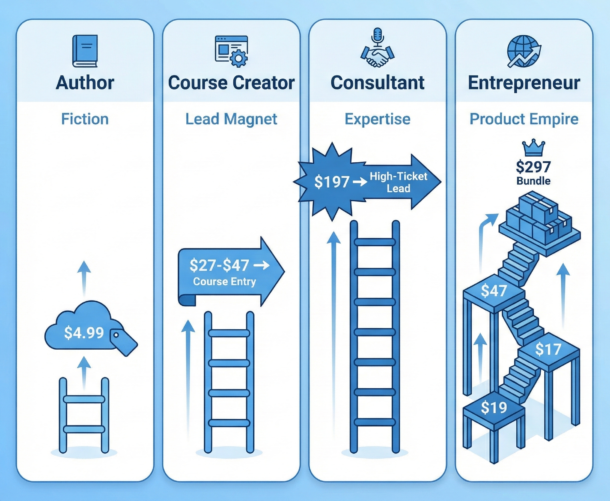
Now let’s get specific about what YOU should charge based on your business model.
Traditional Authors Need Marketplace Visibility and Series Read-Through
Your goal: Maximize readership and series read-through
Platform strategy:
- Primary: Amazon KDP or KDP Select (for Kindle Unlimited access)
- Secondary: Wide distribution (Apple, Kobo) if not in KDP Select
- Tertiary: Direct sales for super-fans
Pricing strategy:
- Book 1 in series: $0 (permafree) or $0.99-$2.99
- Books 2-5 in series: $3.99-$4.99
- Series finale: $4.99-$5.99
- Complete box set: $19.99-$29.99
Genre-specific optimal prices:
- Romance: $3.99-$4.99 (readers consume high volume)
- Mystery/Thriller: $3.99-$5.99
- Science Fiction/Fantasy: $4.99-$6.99
- Literary Fiction: $4.99-$9.99
Why this works: Fiction readers expect marketplace pricing. They browse Amazon, read reviews, and price-compare. Pricing at $3.99-$4.99 positions you competitively while maximizing your per-sale profit within platform constraints.
Course Creators Should Treat Ebooks as Ecosystem Entry Points
Your goal: An education business where ebooks are one component
Platform strategy:
- Primary: Your own platform (Teachable, Thinkific, Kajabi)
- Secondary: Direct sales (Gumroad, Payhip) for standalone ebook sales
- Tertiary: Amazon only if you want broad exposure for lead generation
Pricing strategy:
Tiered approach:
- Lead magnet ebook (free or $9): Email list growth
- Standalone mini-guide ($27-$47): Entry-level paid product
- Comprehensive course ($197-$497): Your core offering
- Ebook plus course bundle ($97-$197): Positions ebook as bonus
Example ecosystem:
- Free checklist (PDF) → Email capture
- $27 ebook on your site → Entry point
- $197 video course → Main product
- $97/month membership → Recurring revenue
Why this works: Your ebook isn’t your business—it’s a gateway. Price it to convert browsers into buyers who then ascend to your course. The $27-$47 price point is low enough to be an impulse purchase but high enough to attract serious learners.
Business Consultants Can Command Premium Prices for Expertise
Your goal: Position yourself as premium expert, generate consulting leads
Platform strategy:
- Primary: Your own website with professional positioning
- Secondary: LinkedIn direct links to your sales page
- Tertiary: Amazon only if required for credibility (use as business card)
Pricing strategy:
Authority-based pricing:
- Diagnostic ebook ($47-$97): “The [Problem] Assessment Framework”
- Implementation guide ($97-$197): Step-by-step how-to for DIYers
- Ultimate guide ($197-$497): Comprehensive resource replacing consulting
Strategic positioning: If your consulting rate is $5,000/project, a $197 ebook is 4% of your fee. This is impulse-territory for your target clients while positioning the ebook as serious professional resource.
Example consultant pricing:
- 30-page strategic brief: $47
- 100-page implementation guide: $97-$197
- 200-page comprehensive methodology: $297-$497
- Ebook plus 1-hour consultation: $997
Why this works: Your ebook is credibility plus lead generation. You’re not selling to mass market—you’re selling to specific professionals who expense business resources. They judge quality by price. A $27 ebook signals “lightweight info.” A $197 ebook signals “serious professional resource.”
Content Creators and Influencers Can Monetize Existing Audiences
Your goal: Monetize your audience across multiple channels
Platform strategy:
- Primary: Gumroad or Payhip (leverage your social media traffic)
- Secondary: Exclusive content for email subscribers
- Tertiary: Ko-fi or Patreon integration for community perks
Pricing strategy:
Audience-based tiering:
- YouTube/Instagram audience (100K+ followers): $19-$47 for standalone ebooks
- Email list (10K+ subscribers): $27-$67 with launch discounts
- Community members (paid Discord/Circle): Free or heavily discounted
Bundle strategy:
- Single ebook: $27
- 3-ebook bundle: $47 (save $34)
- All ebooks plus templates: $97
- Lifetime access to all future ebooks: $197-$297
Why this works: You’ve already built trust through free content. Your audience wants to support you AND get something valuable. The $19-$47 range feels like “supporting a creator” rather than “buying a book,” but it’s substantial enough to be real income.
Entrepreneurs Need a Product Ladder from Entry Point to Premium
Your goal: A scalable digital product business
Platform strategy:
- Primary: Your own Shopify or WordPress site
- Secondary: Gumroad for audience you don’t own yet
- Tertiary: Amazon only if market research shows demand
Pricing strategy:
Product ladder approach:
- Tripwire product ($9-$19): Low-commitment first purchase
- Core product ($27-$97): Your main ebook or bundle
- Premium offering ($97-$297): Ebook plus templates plus bonuses plus email course
- Ultimate bundle ($297-$997): Everything you’ve ever created
Example digital product business:
- SEO beginner’s guide: $19
- Complete SEO toolkit (ebook plus templates): $47
- SEO mastery (ebook plus course plus tools): $197
- Agency bundle (everything plus client materials): $497
Why this works: You’re building a real business, not just selling a book. Each price point serves a different customer segment. The $19 buyer might never buy again. The $497 buyer is your ideal customer. Price accordingly for each segment.
The Hybrid Revenue Model Maximizes Your Earnings from One Ebook

Here’s what the smartest content creators and entrepreneurs do: they sell everywhere at different prices.
The tiered distribution strategy:
Tier 1 on Marketplaces for Discovery
- Amazon/Apple Books: $4.99-$9.99
- Goal: Brand awareness, credibility, reach new audiences
- Accept lower margins for volume and discovery
Tier 2 on Creator Platforms for Conversion
- Gumroad/Payhip: $27-$47 (same ebook, better positioned)
- Goal: Convert your social media audience at higher margins
- Add bonus content (templates, checklists) to justify higher price
Tier 3 on Your Own Platform for Maximum Profit
- Your website: $47-$97 (premium positioning with bonuses)
- Goal: Capture maximum value from your owned audience
- Include email course, community access, or coaching call
Real example of the hybrid model in action:
“The Marketing Framework” ebook:
- On Amazon: $9.99 (earn $6.93 per sale) → Reach 10,000 people
- On Gumroad: $37 (earn $33.30 per sale) → Reach your 50,000 Instagram followers
- On your site: $67 (earn $64.15 per sale) → Reach your 15,000 email subscribers
Same content, three price points, optimized for each audience’s relationship with you.
The math:
- 1,000 Amazon sales × $6.93 = $6,930
- 500 Gumroad sales × $33.30 = $16,650
- 200 website sales × $64.15 = $12,830
- Total revenue: $36,410 from the same ebook
Compare that to selling everything on Amazon at $9.99:
- 1,700 total sales × $6.93 = $11,781
The hybrid model generates 209% more revenue from the same total sales volume.
Price Psychology Principles That Apply to Digital Products
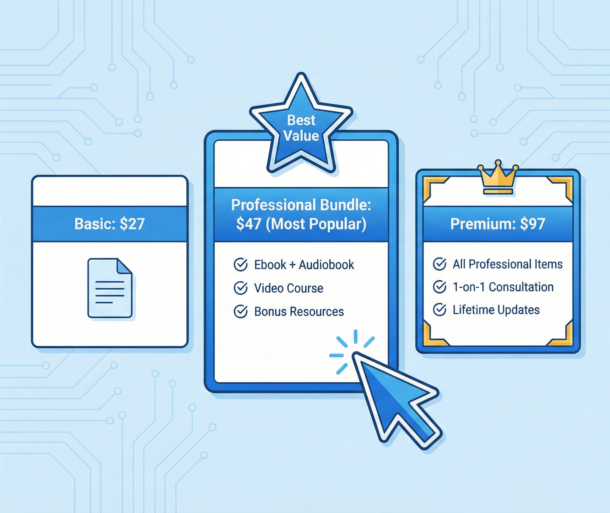
Now let’s talk about the psychology that makes certain price points work better than others.
Why Prices That End in 7 or 9 Outperform Round Numbers
Prices ending in .99 or .97 typically outperform round numbers for products under $100.
The research: A University of Chicago and MIT study found that prices ending in 9 outperformed round numbers by 24%. A $39 item sold better than both $34 and $44 versions.
Best price endings for ebooks:
- $4.97 or $4.99 (not $5.00)
- $6.97 or $6.99 (not $7.00)
- $9.97 or $9.99 (not $10.00)
Exception: Premium positioning. For products over $100 or consulting-adjacent offers, round numbers ($97, $197, $297) signal premium/professional rather than discount.
Three-Tier Pricing Pushes Most Buyers to the Middle Option
When you offer three pricing tiers, most buyers choose the middle option.
The decoy effect:
- Basic tier: $19 (20% of sales)
- Professional tier: $47 (60% of sales) ← Most sales happen here
- Premium tier: $97 (20% of sales)
The premium tier makes the middle tier look reasonable, even if you expected most people to buy the basic tier.
Strategic application: Don’t just offer one ebook at $27. Offer:
- Ebook only: $27
- Ebook plus templates: $47 ← Most buyers pick this
- Ebook plus templates plus mini-course: $97
Average order value with one option: $27 Average order value with three options: $52 (93% increase)
Low Prices Signal Low Quality for Professional Content
Pricing too low signals low quality, especially for professional content.
A case study from pricing research: A publisher raised their newsletter subscription from under $100 to over $100 (31% increase). They expected 31% fewer orders but actually received 11% MORE orders—the higher price attracted better-fit customers.
Warning signs you’re underpriced:
- Zero price resistance (everyone says yes immediately)
- Customers buy without reading the description
- High refund/complaint rates (wrong audience attracted by low price)
- Customers asking for more support than the price justifies
Test for optimal price: Raise your price 30%. If sales drop less than 20%, your revenue increased. Keep raising until revenue plateaus.
Different Markets Have Different Price Expectations
Different markets have wildly different price expectations.
Price sensitivity by market:
- US market: Standard pricing, willing to pay for quality
- UK market: 20-30% more price-sensitive than US
- EU markets: Varies by country; Germany less sensitive, Southern Europe more sensitive
- India: Expect 60-80% lower prices than US
- Brazil: Expect 50-70% lower prices than US
- Australia: Similar to US but limited market size
Strategic approach: Use platforms like Payhip that allow regional pricing. Set your US price as baseline, then:
- UK: 85% of US price
- EU: 80-90% of US price
- India: 20-30% of US price
- Brazil: 30-40% of US price
A $47 US ebook might be $39 in UK, $14 in India, $18 in Brazil—each optimized for local purchasing power while maintaining your global revenue.
How to Test and Optimize Your Price Over Time
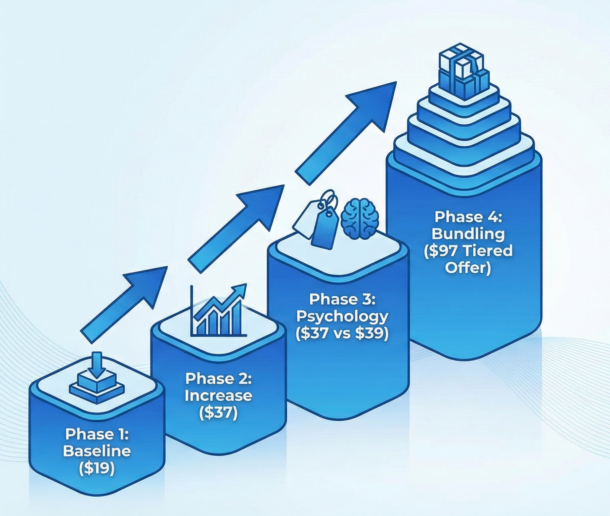
Pricing isn’t a one-time decision. It’s an ongoing optimization process.
A Four-Phase Price Testing Framework
Phase 1: Establish baseline (Weeks 1-2)
- Launch at your initial price
- Track daily: units sold, revenue, traffic source, conversion rate
- Minimum 50 transactions for meaningful data
Phase 2: Test higher price (Weeks 3-4)
- Increase price by 40-50% (e.g., $27 to $47)
- Continue tracking same metrics
- Calculate: Did total revenue increase even if volume decreased?
Phase 3: Test psychological pricing (Weeks 5-6)
- Try $47 vs. $49 vs. $44
- Test $97 vs. $99 vs. $89
- Often $47 and $97 outperform because they feel “not quite $50” or “not quite $100”
Phase 4: Test bundling (Weeks 7-8)
- Offer single ebook vs. ebook plus bonus
- Test price points for bundles
- Often bundles at 1.5-2x single ebook price increase average order value significantly
Critical metric: Revenue per visitor (not just conversion rate)
- 100 visitors × 5% conversion × $27 = $135
- 100 visitors × 3% conversion × $47 = $141 (winner despite lower conversion)
The Tools You Need to Track Performance
For your own website:
- Google Analytics: Track traffic and behavior
- ThriveCart or SamCart: Built-in A/B testing for checkout pages
- Hotjar: See where visitors drop off
- Stripe Dashboard: Track revenue and payment patterns
For creator platforms:
- Gumroad Analytics: Built-in conversion tracking
- ConvertKit: Email campaign performance
- Teachable Insights: Course sales analytics
Essential tracking spreadsheet columns:
- Date
- Price point
- Traffic source
- Visitors
- Sales
- Conversion rate
- Revenue
- Revenue per visitor
Review weekly. Look for trends over 2-4 weeks, not daily fluctuations.
When to Raise or Lower Your Prices
Quarterly review (every 3 months):
- Is your current price optimal based on conversion data?
- Has your competitor pricing changed?
- Has your brand authority increased (more reviews, followers, credibility)?
After reaching credibility milestones:
- First 100 sales: Consider 20-30% price increase
- First 1,000 email subscribers: Test premium positioning
- First major media mention/podcast: Raise prices to match elevated brand perception
Seasonal considerations:
- January: Buyers have holiday money and New Year motivation (raise prices)
- November: Black Friday sales (40-60% off, but only 3-5 days)
- Launch periods: Start higher, never lower (you can always run sales later)
Never forget: You can always lower prices. Raising prices after launch feels like betraying early customers. Start at the high end of reasonable, then test downward if needed.
Seven Expensive Mistakes Content Creators Make with Ebook Pricing
I’ve consulted with hundreds of creators on pricing strategy. These mistakes cost them thousands.
Mistake 1 – Author Pricing Strategies Don’t Work for Business Content
Fiction author strategy doesn’t work for content creators.
Fiction authors price at $3.99-$4.99 because:
- They’re competing in entertainment marketplace
- Readers buy dozens of books per year
- Volume matters more than margin
Content creators should price higher because:
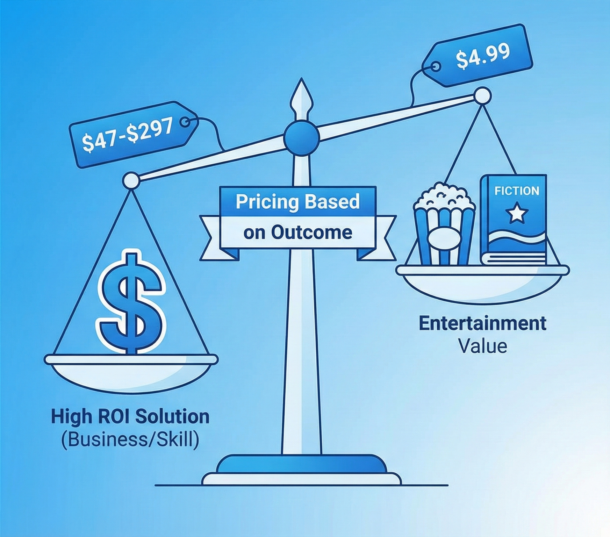
- You’re selling solutions, not entertainment
- Buyers purchase for ROI, not entertainment value
- One buyer at $47 = six buyers at $7.99 (work smarter, not harder)
What to do instead: If you’re selling business content, professional development, or skill-building, ignore Amazon pricing entirely. Start at $27 minimum.
Mistake 2 – Competitor Prices Don’t Determine Your Value
Your competitors’ prices don’t determine your value.
If someone else sells a similar ebook for $19, that doesn’t mean you should price at $17 to “win.” They might be:
- Growing an email list (price is intentionally low)
- Selling low-quality content
- Established with huge audience (can profit on volume)
What to do instead: Price based on:
- The ROI you deliver (can your $47 ebook save someone $5,000?)
- Your positioning (premium expert vs. budget option)
- Your target customer (executives expense $97; students balk at $27)
Mistake 3 – Single Product Offers Leave Money on the Table
Selling only single ebooks leaves money on the table.
Single ebook model:
- $27 ebook
- Average order value: $27
Bundle model:
- Ebook alone: $27
- Ebook plus templates: $47
- Ebook plus templates plus video walkthrough: $77
With proper positioning, 40-60% of buyers will choose an upgraded bundle.
New average order value: $45-50 (67-85% increase)
What to do instead: Create three tiers for everything you sell. Make the middle tier the obvious value, but price the top tier to make middle tier look reasonable.
Mistake 4 – Your Audience Size Should Change Your Pricing Strategy
Your pricing strategy should change as your audience grows.
With 0-1,000 email subscribers:
- Focus on marketplace platforms (Amazon, Gumroad)
- Price competitively ($9.99-$27)
- Goal: Audience growth and testimonials
With 1,000-10,000 email subscribers:
- Add direct sales channel
- Test premium pricing ($27-$67)
- Goal: Increase per-customer revenue
With 10,000+ email subscribers:
- Primary focus on direct sales
- Premium pricing ($47-$197)
- Goal: Maximize margin on owned traffic
What to do instead: Audit your audience size quarterly and adjust pricing strategy accordingly.
Mistake 5 – Platform Fees and Taxes Eat Into Your Real Margins
Your pricing needs to account for platform fees, payment processing, and taxes.
Real margin calculation for $47 ebook on different platforms:
Amazon (if priced at $9.99 maximum):
- Gross: $9.99
- Amazon royalty (70%): $6.99
- Delivery fee: -$0.30
- Net: $6.69 (67% margin)
Gumroad:
- Gross: $47
- Gumroad fee (10%): -$4.70
- Payment processing (2.9% + $0.30): -$1.66
- Net: $40.64 (86% margin)
Your own site with Payhip:
- Gross: $47
- Payhip fee (5%): -$2.35
- Payment processing (2.9% + $0.30): -$1.66
- Net: $43.99 (93% margin)
Plus EU VAT (5-27%) on EU sales, which platforms may or may not handle for you.
What to do instead: Use a pricing calculator that includes all fees. Your target net revenue should be your starting point, then work backward to set the displayed price.
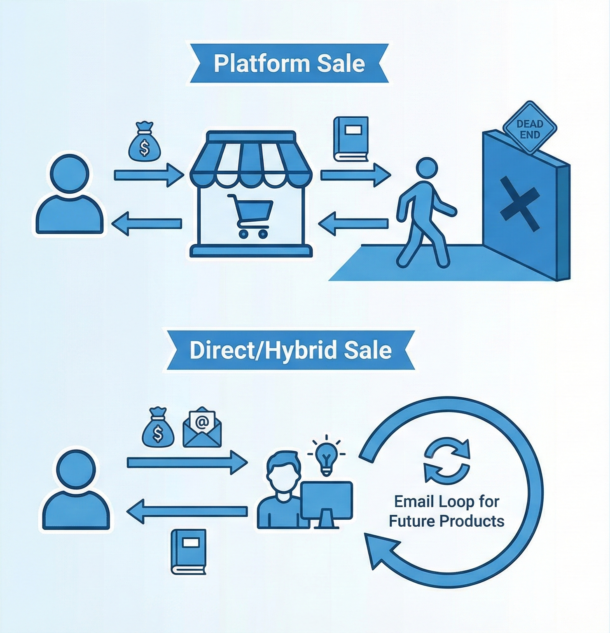
Mistake 6 – Platform Sales Are Someone Else’s Customers
Every sale through a platform is someone else’s customer.
When someone buys from Amazon or Gumroad, you get their money. You don’t get their email address (unless they opt in separately). You can’t market your next product to them.
The cost of not capturing email addresses:
- Customer buys your $27 ebook on Gumroad
- You earn $22 after fees
- You launch your next ebook six months later
- That customer never hears about it because you can’t email them
- Lifetime customer value: $22
With email list capture:
- Customer buys your $27 ebook and joins your email list
- You earn $22 after fees
- Over two years, you email them about 3 more ebooks
- They buy 1.5 on average at $37 each
- Lifetime customer value: $77 (3.5x higher)
What to do instead: Every sales page should offer a “buy plus join my email list” option. Give a small bonus (PDF checklist, template, short video) in exchange for their email.
Mistake 7 – Launch Prices Should Start High with Early-Bird Discounts
You can always run sales. You can’t easily raise prices without angering early buyers.
The mistake:
- Launch ebook at $19 because you’re nervous
- Get 100 sales at $19
- Realize you should have charged $37
- Raise price to $37
- Early buyers feel cheated when they see price increased
The smart approach:
- Launch at $47 (your target price)
- Offer early-bird discount to email list: $27 for first week
- Move to $37 for weeks 2-4 (still “discounted”)
- Settle at regular price of $47 after launch period
- Early buyers got a deal; new buyers pay full price
What to do instead: Start high with temporary discounts for early buyers. This way early buyers feel special (they got a deal), and you can maintain your target price long-term.
Learn other ebooks mistakes to avoid
How to Choose Your Platform and Price Based on Where You Are Now
The right pricing decision depends on three factors: your current audience size, your business model, and your growth goals. Use the decision framework below to find your starting point.
Platform Selection Based on Your Current Audience
| Your Current Situation | Recommended Primary Platform | Why This Works |
|---|---|---|
| No audience yet (0-500 subscribers) | Amazon KDP or Gumroad | You need marketplace discovery. Accept lower margins to build visibility and collect testimonials. |
| Small audience (500-2,000 subscribers) | Gumroad or Payhip | You have enough traffic to test direct sales. Lower fees than Amazon, and you keep customer emails. |
| Medium audience (2,000-10,000 subscribers) | Payhip or Teachable | Your audience justifies premium pricing. Focus on maximizing revenue per customer. |
| Large audience (10,000+ subscribers) | Your own website (Shopify/WordPress) | You have the traffic to support 95% margins. Full control over pricing and customer experience. |
Price Selection Based on Your Content Type
| What You’re Selling | Marketplace Price | Direct Sales Price | Premium Tier Price |
|---|---|---|---|
| Fiction novel (70,000+ words) | $3.99-$4.99 | $7.99-$9.99 | $14.99 (signed/bonus edition) |
| Short guide (20-50 pages) | $2.99-$4.99 | $9-$19 | $27 (with templates) |
| Comprehensive guide (100+ pages) | $7.99-$9.99 | $27-$47 | $67-$97 (with course access) |
| Professional/business content | $9.99 (ceiling) | $47-$97 | $197-$297 (with consulting) |
| Course companion ebook | Free with course | $27-$47 standalone | $97 (with video walkthrough) |
The Three Questions That Determine Your Starting Price
Question 1: What transformation does your ebook deliver?
If your ebook helps someone save $5,000 or earn an additional $10,000, a $97 price is 1-2% of the value delivered. If your ebook provides entertainment for a few hours, $4.99 aligns with what readers expect to pay for that experience.
Question 2: Who is your ideal buyer?
Executives and business owners expense purchases and evaluate ROI. They’ll pay $197 for content that solves real problems. Students and hobbyists have limited budgets and compare prices across options. They respond to $19-$27 pricing. Match your price to your buyer’s budget and purchasing behavior.
Question 3: What’s your revenue goal for this ebook?
Work backwards from your target. If you want to earn $5,000 from this ebook and expect 200 sales, you need $25 net revenue per sale. On Gumroad (85% net after fees), that means pricing at approximately $29. On Amazon (70% royalty minus delivery), you’d need to price at $9.99 and sell 720 copies instead.
Tier Structure Decision Guide
Rather than offering a single price, most successful creators offer three tiers. Here’s how to structure yours:
| Tier | What to Include | Price Multiplier | Expected Sales Mix |
|---|---|---|---|
| Basic | Ebook only | 1x (your base price) | 20-30% of buyers |
| Plus | Ebook plus templates, checklists, or bonus chapter | 1.5-1.8x base price | 50-60% of buyers |
| Premium | Everything plus video content, community access, or email course | 2.5-3x base price | 15-25% of buyers |
Example with $27 base price:
- Basic: $27 (ebook only)
- Plus: $47 (ebook plus 3 templates plus bonus chapter)
- Premium: $77 (everything plus 30-minute video walkthrough)
This structure typically increases average order value by 60-90% compared to single-price offers.
When to Revisit Your Pricing Decisions
Pricing isn’t permanent. Schedule reviews based on these milestones:
| Milestone | Action to Consider |
|---|---|
| First 50 sales | Review conversion rate. If above 4%, test a 20% price increase. |
| First 100 reviews/testimonials | Raise prices 15-25%. Social proof supports higher pricing. |
| Email list doubles in size | Shift more sales to direct channels where margins are higher. |
| Quarterly (every 3 months) | Audit tier mix. If 70%+ buy basic tier, your Plus tier needs better value. |
| Major credibility event (podcast, press, award) | Raise prices immediately. Your perceived value just increased. |
| Black Friday / January | Plan seasonal promotions (40-60% off) or price increases (New Year motivation). |
The Hybrid Model Decision Tree
If you’re unsure whether to focus on marketplaces or direct sales, use this framework:
Start with marketplaces if:
- You have fewer than 1,000 email subscribers
- You’re in a genre where readers browse Amazon (fiction, general non-fiction)
- You need reviews and social proof before raising prices
- You don’t have time to drive your own traffic
Start with direct sales if:
- You have an existing audience from YouTube, podcasts, or social media
- Your content serves a professional audience that expects premium pricing
- You want to bundle ebooks with courses, coaching, or other products
- You need customer email addresses for future launches
Use both (hybrid model) if:
- You have 2,000+ email subscribers AND want marketplace discovery
- You’re willing to manage multiple platforms
- You want to test which audience segment pays more
- You’re building a long-term content business, not just selling one ebook
The hybrid approach generates the highest total revenue but requires more setup and management. Start with one platform, prove your concept works, then expand.
Summary of Recommended Prices by Business Model
After analyzing pricing across platforms and business models, here’s your starting framework:
| Your Business Model | Primary Platform | Price Range | Core Strategy |
|---|---|---|---|
| Traditional fiction author | Amazon KDP or KDP Select | $3.99-$4.99 | Volume through marketplace discovery |
| Course creator | Teachable/Thinkific plus Gumroad | $27-$97 standalone, free as course bonus | Ebooks as ecosystem entry points |
| Business consultant | Your own website | $47-$297 | Premium positioning for professional audience |
| Content creator/influencer | Gumroad or Payhip | $19-$67 | Multiple tiers to maximize average order value |
| Digital product entrepreneur | Hybrid (Shopify plus marketplaces) | $27 marketplace, $47-$97 direct | Marketplaces for discovery, direct for margin |
Above all else: Don’t let platform limitations dictate your business model. If Amazon’s $9.99 ceiling doesn’t work for your content, don’t use Amazon as your primary channel.
Your ebook has value. Your expertise has value. Your audience relationships have value.
Price accordingly for the platform and business model that serves YOUR goals—not the platform’s goals.
Now go set up your sales page and let your data tell you what price works best.
Final Reminder: These strategies are based on industry data and successful creator case studies. Your specific results will depend on your audience size, niche competition, content quality, and marketing approach.
| Always Do This | Why It Matters |
|---|---|
| Research pricing in YOUR specific niche first | Generic advice may not apply to your market |
| Test multiple price points with real traffic | Data beats assumptions every time |
| Track revenue, not just sales volume | 50 sales at $47 beats 100 sales at $19 |
| Adjust quarterly as your platform grows | Your pricing power increases with your audience |
| Capture email addresses on every platform | Platform customers are temporary; email subscribers are yours forever |
The most successful content creators use a hybrid model: marketplaces for discovery, direct sales for profits, and email lists for long-term customer relationships. Start wherever makes sense for your current situation, then expand as you grow.
Frequently Asked Questions About Ebook Pricing
Get answers to the most common questions about pricing your ebook across different platforms
Why does Amazon cap ebook prices at $9.99 for the 70% royalty rate?
Amazon’s royalty structure is designed to keep ebooks competitively priced for consumers. At prices between $2.99 and $9.99, authors earn 70% royalties. Above $9.99, the royalty drops to 35%, meaning you’d earn only $5.25 on a $14.99 ebook compared to $6.93 on a $9.99 ebook. This makes Amazon unsuitable for premium-priced business or professional content.
What’s the difference between selling on marketplaces versus direct sales platforms?
Marketplaces like Amazon provide built-in audiences but limit your pricing flexibility and take larger revenue cuts. Direct sales platforms like Gumroad, Payhip, or your own website give you complete pricing freedom (from $0 to $997+) and let you keep 85-95% of each sale. The trade-off is that you need to drive your own traffic through an email list or social media presence.
How should I price my ebook if I’m a course creator?
Course creators should treat ebooks as ecosystem entry points, not primary products. Price standalone ebooks between $27-$97 on platforms like Teachable or Thinkific. Use free or low-priced ebooks ($0-$9) as lead magnets to grow your email list, then offer your comprehensive ebook at $27-$47 as an entry-level paid product that funnels buyers toward your main course.
What’s the hybrid revenue model and why is it effective?
The hybrid model sells the same ebook at different prices across multiple platforms. For example, sell at $9.99 on Amazon for discovery, $37 on Gumroad for your social media audience, and $67 on your own website for email subscribers. This approach can generate over 200% more revenue than selling exclusively on one platform because you’re optimizing for each audience’s relationship with you.
Should I price my ebook with numbers ending in 7 or 9?
Research shows prices ending in 9 outperform round numbers by about 24% for products under $100. Use prices like $4.97, $6.99, or $9.99 rather than round numbers. However, for premium products over $100 or consulting-adjacent offers, round numbers like $97, $197, or $297 signal professional value rather than discount pricing.
How do I calculate my actual earnings after platform fees?
Your net earnings vary significantly by platform. A $47 ebook on Amazon (capped at $9.99) earns about $6.69 after the 70% royalty and delivery fees. The same $47 ebook on Gumroad earns approximately $40.64 after their 10% fee and payment processing. On Payhip with their 5% fee, you’d keep about $43.99. Always calculate net revenue, not list price, when comparing platforms.
Why should I offer three pricing tiers instead of a single price?
Three-tier pricing leverages the decoy effect, where most buyers choose the middle option. Offer your ebook alone at a base price, add templates or bonuses at 1.5-1.8x the base, and include video content or community access at 2.5-3x. This structure typically increases average order value by 60-90% because 50-60% of buyers will choose the middle tier.
How should I adjust pricing for international markets?
Different regions have different price sensitivities. Use your US price as baseline, then set UK prices 15% lower, EU prices 10-20% lower, India prices 60-80% lower, and Brazil prices 50-70% lower. Platforms like Payhip allow regional pricing. Always set regional prices manually rather than relying on automatic currency conversion, which may accidentally drop you below royalty tier thresholds.
When should I raise my ebook price?
Consider raising prices after reaching credibility milestones: your first 100 sales (test a 20-30% increase), reaching 1,000 email subscribers (test premium positioning), or after major media mentions or podcast appearances. Also review quarterly—if your conversion rate is above 4%, you’re likely underpriced. Start high with launch discounts rather than launching low and raising later.
What’s the biggest pricing mistake content creators make?
The most expensive mistake is using fiction author pricing strategies for business content. Fiction authors price at $3.99-$4.99 because they’re competing in an entertainment marketplace where readers buy dozens of books yearly. Content creators selling solutions, professional development, or skill-building should start at $27 minimum because buyers purchase for ROI, not entertainment. One sale at $47 equals six sales at $7.99.